


On this page, you’ll find everything you need to know about condoms. When used correctly, they’re a highly effective way to reduce the spread of STBBIs and prevent unplanned pregnancies without minimizing sensation.
We put together a “Condoms 101” guide that covers all the essentials so you can get the most out of condoms: for protection and pleasure!
A condom is a thin, flexible sheath designed to block blood, semen, saliva, and vaginal or penile secretions. It’s worn on the penis or placed over a sex toy to prevent direct contact with the skin and mucous membranes (mouth, vagina, anus) and to prevent the exchange of semen and other bodily fluids.
Heat, humidity, and cold can all damage latex, reducing the condom’s effectiveness without you realizing it. Avoid keeping your condoms in your car, jeans pocket, or wallet for weeks on end. Friction and compression can damage them.
Unplanned sex can happen quickly, and not having a condom on hand can really kill the mood. Even if you think it won’t happen to you, it’s better to be prepared. It’s often the times we fail to plan ahead that lead to regret. Besides, a condom takes up little to no space! Why keep more than one on you? Because you have to change condoms after each oral, vaginal or anal sexual encounter and each time you switch from one area to another. Not to mention . . . You might need to be prepared for a second round!
A condom becomes less effective when it expires. The expiration date can be found on the box, but also on the packaging of each condom. Including an expiration date is a legal requirement, so if it’s not there, throw the condom away
Because condoms are made of organic materials, they do eventually expire (after about 3 to 5 years). Over time, latex becomes more porous and fragile, which increases the risk of tearing. Additionally, the lubricant that coats the condom can dry out, making the condom even more likely to break with friction.
If you’ve ever experienced irritation or discomfort when using a condom, that might mean you have a latex allergy. Don’t worry, there are synthetic latex condoms available that offer the same level of protection against STBBIs and unplanned pregnancies without causing irritation.
Some people even prefer latex-free condoms because they don’t have as strong a smell as traditional condoms. Although they cost more, the comfort they provide is worth the price.
Finding the right condom size is important. A poorly fitting condom can be less effective and alter sensations. Pharmacies generally stock three sizes: snug, standard, and large.
To find out which size is right for you, you can either try some (on an erect penis — by yourself, at home) or measure your erect penis with a ruler or tape measure before shopping for them. Then, during your next pharmacy visit, it will be easier to compare your measurements with the size information on the condom packaging.
There are a wide range of condoms available: textured, coloured, flavoured, thinner, thicker, ribbed, and more. You may even have a preference for a specific brand! Don’t hesitate to try several types to find the one that suits you best.
Just keep in mind that flavored condoms should only be used for oral sex, not for penetration.
You can buy condoms at any pharmacy. If you can't find what you're looking for there, check out big box or adult stores instead. Condom brand websites sometimes offer a wider variety of sizes and styles. You can also get them for free from certain community organizations or healthcare professionals.
Sexual activities such as oral sex, sharing sex toys, skin-to-skin contact between genitals, or mutual masturbation without protection are practices associated with STBBI transmission. Another example of a non-penetrative practice associated with STBBIs is touching someone else’s genitals with your hands and then touching your own.
To reduce the risk of contracting or transmitting an STBBI, you can use one of the following, depending on the sexual activity: a condom, a dental dam (or sexual dam), a latex glove, or a latex finger.
You can obtain these barrier methods at specialty stores, some student associations, or your school's health services office.
Check out Club Sexu's article to learn everything you need to know about lubricants.
You can even make your own dental dam from a condom:
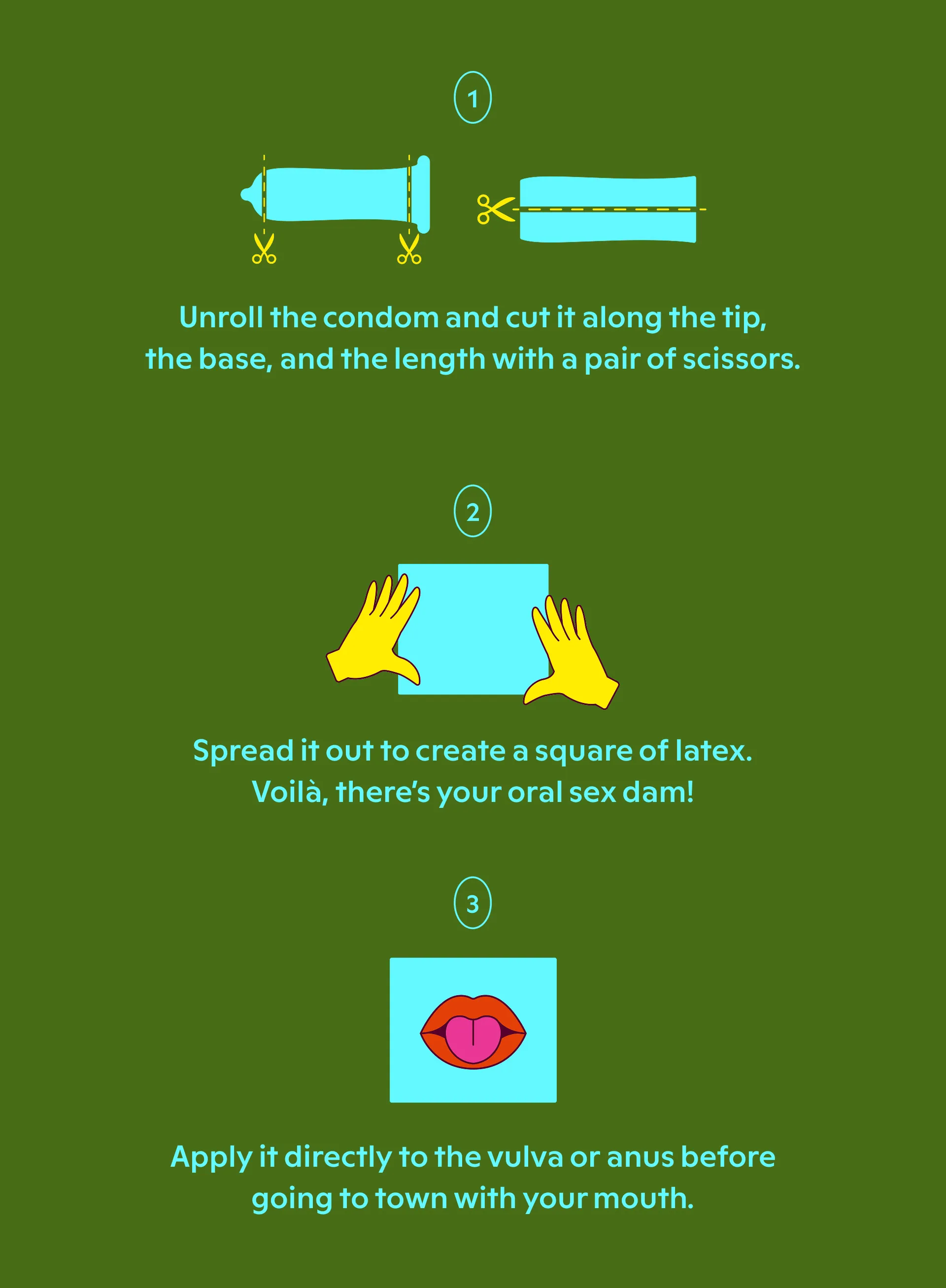
The act of putting on and handling a condom or a dental dam can help you feel more comfortable and confident before and during each sexual encounter.
Also, remember to clean your sex toys with mild soap after each use. Toys can transmit STBBIs when shared or used without being cleaned properly, so this step is essential, just like using a condom.
Adding lubricant helps the condom glide on more easily and reduces the risk of tearing. You can apply it to the outside of the condom, but also a drop or two on the inside for optimal glide.
Important: use only water- or silicone-based lubricants. Oil-based lubricants (like petroleum jelly or coconut oil) can damage latex and make the condom less effective.
Good to know: saliva is not a good lubricant, as it can transmit STBBIs.
For oral sex, you can also try a flavoured lubricant: it’s safe and enjoyable. This type of lubricant should not be used for penetration, as it can cause infections.
Although it may seem to provide “double protection,” wearing two condoms at the same time does exactly the opposite.
The friction between the two layers increases the risk of tearing: it’s less safe, not more safe! You’re better off using just one condom that fits and is well lubricated.
Once the sexual activity is over, hold the condom at the base of the penis or sex toy to prevent it from slipping off and to keep semen (if any) from spilling out. Only remove the condom once there is no longer any contact with your partner’s body, making sure that no fluids spill.
The condom should be disposed of in the trash, never in the toilet: it can block the pipes and is not environmentally friendly. To dispose of it discreetly, wrap it up in a tissue or any other type of object that hides it well.











You are leaving the Oh ouiii website. You will be redirected to the Club Sexu website.